
Roller Coaster Types: A Buyer Map From Family to Looping
Coaster catalogues are full of names that mean nothing to a first-time buyer. This is the map we draw on paper for customers: what each type actually does, what it needs from your site, and who it is for.
The Five Types Worth Understanding
| Type | What it is | Typical height | Who buys it |
|---|---|---|---|
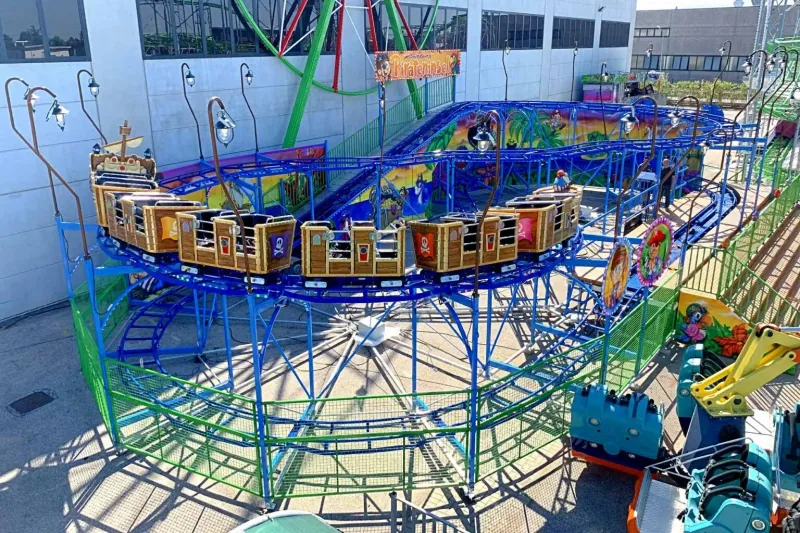
| Family / kiddie coaster | Gentle gravity or powered circuit for small children and parents | 6 – 15 m | FECs, family parks, zoos |
| Powered coaster | On-board drive, so no lift hill and no gravity requirement | 6 – 12 m | Indoor parks, small footprints |
| Spinning coaster | Cars rotate freely as they travel, so every ride is different | 10 – 20 m | Parks wanting repeat rides from thrill-seekers |
| Shuttle / boomerang | Runs out and back on the same track, often with a vertical spike | 15 – 40 m | Compact sites, high thrill per square metre |
| Looping / multi-loop | One to three inversions with lift hill and high speed | 15 – 35 m | Thrill parks with real throughput |
Gravity, Powered or Spinning: How to Choose
Gravity coasters need a lift hill and height for the drop, so they need land and a signature skyline. Powered coasters keep constant speed under their own drive, which lets them run flat layouts indoors and keeps the ride accessible to younger children. Spinning coasters take the same track as a standard coaster but let the car rotate on its own axis — they are the cheapest way to raise repeat ridership, because the same track yields a different ride each time.
Capacity Is Where Coasters Differ Most
A coaster that looks impressive can be a commercial disappointment if it moves too few people. Rules of thumb from our own installations:
- Kiddie and family trains: 8–20 passengers per train, 45–75 second cycles including load and unload, often two trains on the circuit.
- Mid-size spinning and family launch coasters: 12–24 passengers, 60–120 second cycles, one or two trains.
- Looping coasters: 12–24 passengers with the longest load time, because restraints are more involved — check the restraint procedure before you believe a headline hourly figure.
Always ask for the throughput figure with the cycle time and the number of trains attached to it, then halve it for planning.
What the Site Has to Give
- Footprint: a compact family coaster can fit in 30 m by 15 m; a mid-size layout wants 60 m by 25 m or more, plus the station and queue building.
- Foundations: individual footings under each track support, set from our drawings — usually far less concrete than a drop tower or wheel, but unforgiving on position tolerance.
- Clear height and clearance envelope: including the space a rider’s arms and loose clothing occupy.
- Power for the lift motor, drive and control system, plus a station area with safe loading and unloading zones.
- Queue design: on a coaster, the queue is part of the ride experience and part of your throughput.
Certification and Documents
Coasters attract the most scrutiny from regulators of any ride class. Expect to need structural calculations, foundation drawings, track and weld inspection records, material certificates, restraint and brake system documentation, a factory load test report and a full operation and maintenance manual. For EU markets, machinery safety conformity documentation supports your CE technical file. Our standard handover pack covers all of it, and we will tell you up front what your market’s regulator is likely to ask for.
Common Buying Mistakes
- Buying on track length or top speed instead of hourly capacity.
- Underestimating the station and queue building — it is often the biggest single construction item.
- Choosing a coaster that no child in your market can ride because the height restriction is wrong.
- Skipping the spare parts float. A coaster down for a week in high season costs more than a year of spares.
- Treating certification documents as paperwork to be sorted out later. Get them at order confirmation, not at the port.
Which One Should You Buy First?
If your park is new, a family or powered coaster is almost always the right first coaster: lower capital, lower height restriction so the whole family rides, easier certification and a footprint that leaves room for everything else. Add a spinning or looping coaster in year three or four, once the queue data tells you exactly what your guests will pay for. Send us your site drawing and tell us your target market — we will map the options on your actual land.
Frequently Asked Questions
What is the difference between a family coaster and a thrill coaster?
Family coasters run at lower speeds and heights with a low height restriction so children and parents ride together. Thrill coasters add speed, inversions and heavier restraint systems, with a higher height restriction and stricter loading procedure.
How much space does a roller coaster need?
A compact family or powered coaster can be laid out in roughly 30 m by 15 m including the station. Mid-size layouts typically want 60 m by 25 m or more, plus a queue area and access paths, with individual footings under each track support.
Are spinning coasters worth it?
They are usually the best value upgrade for repeat ridership. The track is comparable to a standard coaster, but the rotating car makes every ride different, so guests queue twice as often.
What documents do I need for a coaster purchase?
Structural calculations, foundation drawings, track and weld inspection records, material certificates, restraint and brake documentation, a factory load test report and operation and maintenance manuals — plus market-specific certification documentation where your regulator requires it.
Buying a ride is a 10-year relationship with a factory. Choose the partner, not just the price.
Get Personalized Advice
Our engineers answer buyer questions daily — site fit, budgets, documents for your market.
Continue Reading
- Bumper Cars: What We Tell Buyers at the Factory (Not in the Brochure) →
- How to Choose an Amusement Ride Manufacturer in China →
- How Much Does an Amusement Ride Cost? 2026 Price Guide →
- Importing Amusement Rides: Shipping, Customs & Installation →
- Amusement Ride Safety Standards: CE, ISO & Third-Party Inspection →
- How Many Bumper Cars Do I Need? Arena Size, Layout and Throughput →
- What Does a Bumper Car Arena Earn? A Realistic ROI Model →
- Bumper Car Maintenance: The Daily, Weekly and Annual Checklist →
- Ferris Wheel Buying Guide: Sizes, Costs and Site Requirements →
- Drop Tower Buying Guide: Heights, Capacities and Safety Systems →
- Shipping Amusement Rides From China: Containers, Codes and Paperwork →
- Best Amusement Rides to Start a Business: 6 Rides Worth Buying First →
- Indoor Amusement Rides: What Actually Fits in a Mall or FEC →